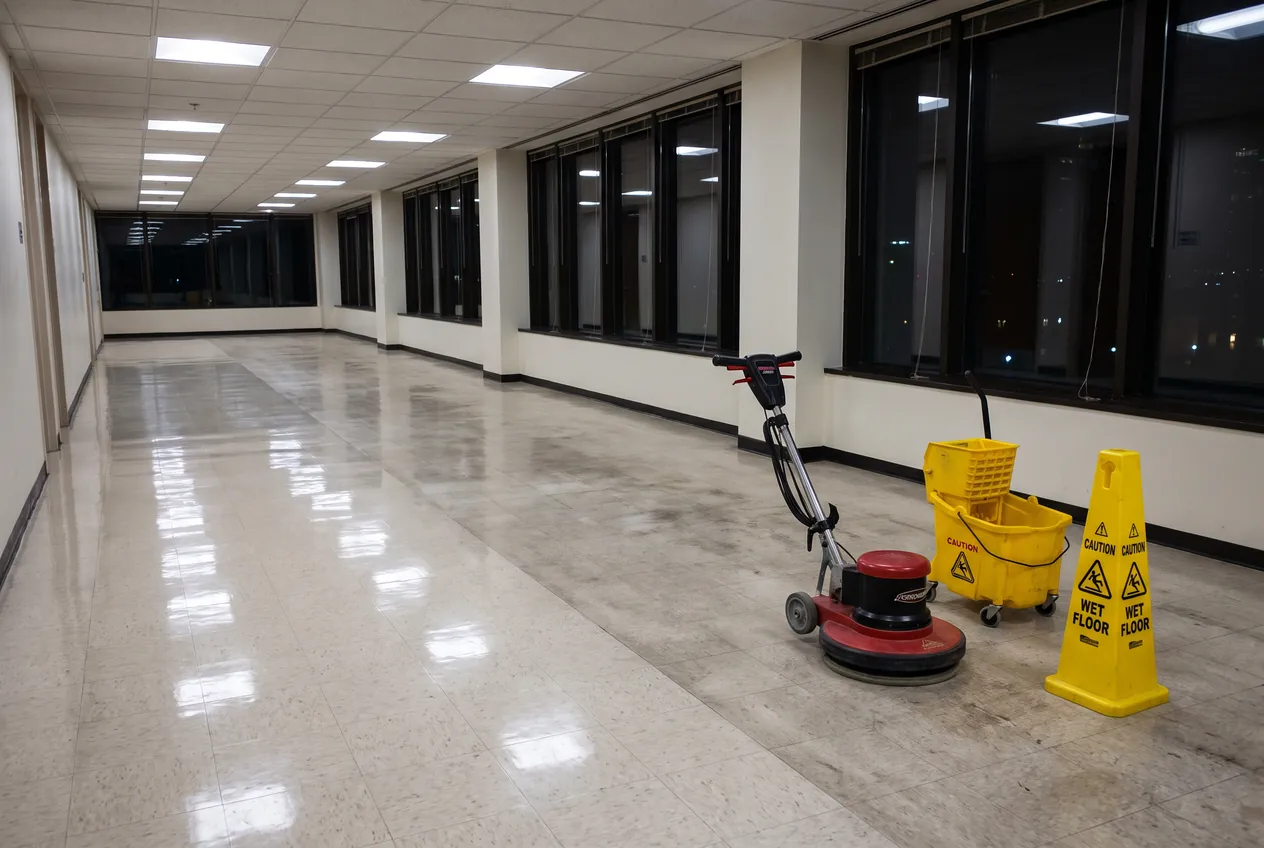
What the job really is
Wax is the old name. What goes on a commercial floor now is an acrylic finish, a liquid that dries into a clear, hard film. That film is a sacrificial layer. It takes the grit, scuffs and rolling carts, and the tile underneath stays intact. Once the film wears through in walkways or turns gray from ground-in soil, mopping cannot bring it back.
Stripping dissolves the worn film and lifts it off. Refinishing puts a fresh one down. The floor that gets this treatment most often is vinyl composition tile, or VCT, the square tile found in school hallways, clinic corridors, break rooms, retail aisles and back offices. It holds up well, it is cheap to replace in patches, and it takes finish evenly when the prep is done right.
Check the floor before anyone books a machine
Stripper is built to break down finish, and it does not know the difference between finish you want gone and a factory wear layer you paid for. Many luxury vinyl tile and plank products and most no-wax sheet floors should never be stripped. Pull the floor maker's care instructions before the work order goes out, and hand them to the cleaning company. If nobody can find them, ask the provider to test a small, hidden spot first.
- VCT: the standard candidate for a full strip and refinish
- Luxury vinyl tile and plank: only if the manufacturer allows it
- No-wax or factory-coated sheet vinyl: leave the coating alone
- Sealed or polished concrete: follows its own maintenance plan
- Marble, travertine and other stone: needs stone-specific care
- Rubber floors: use only products approved for rubber
- Any floor under warranty: read the care terms first
Step by step, from bare room to cured finish
Each step below has a job. Cutting one short usually shows up a few weeks later as finish that peels at the edges, looks cloudy, or feels slick underfoot. A careful crew works through them in order and does not rush the drying.
| Step | What the crew does | Why it matters |
|---|---|---|
| Clear the space | Moves furniture, mats, bins and displays out | Finish cannot be laid under anything left in place |
| Dust mop | Removes loose sand and grit | Grit trapped under the pad scratches tile |
| Post signs | Puts wet floor signs at every way in | Stripper makes the floor very slippery |
| Apply stripper | Spreads solution and lets it dwell | Dwell time does most of the work |
| Scrub | Runs a low-speed machine with a stripping pad | Breaks the old film loose from the tile |
| Pick up slurry | Wet vacuums the dissolved finish | Leftover slurry dries into a gummy layer |
| Rinse and neutralize | Rinses clean, often twice, then neutralizes | Stripper residue keeps new finish from bonding |
| Dry | Lets the bare tile dry fully | Moisture under finish turns it cloudy |
| Finish coats | Applies several thin coats, often 3 to 5 | Thin coats cure hard; thick ones stay soft |
| Burnish later | Optional high-speed pass once cured | Adds shine and toughens the surface |
Desert dust, dry air and heat in the valley
Wind across the Las Vegas Valley carries fine, abrasive dust through every door that opens. It lands on entry mats, gets tracked a few steps in, and grinds against the finish like fine sandpaper. That is why the first several feet inside an entrance go dull long before the rest of the floor. Good matting and frequent dust mopping at entries do more to stretch the time between strips than anything else.
Low humidity helps the work itself, since coats often dry faster here than in a damp climate. Faster is not the same as ready. Summer heat inside a closed suite, or an HVAC system shut down for the night, can make finish dry too quickly on top and stay soft underneath, while cold supply air blowing straight down can leave marks. The finish label sets the recoat time, not the weather.
Scheduling around long operating hours
Plenty of buildings in Las Vegas, Henderson and North Las Vegas run late shifts or stay open around the clock, so there is no quiet weekend to hand the crew. The answer is zones. The provider strips and finishes one section at a time, ropes it off, and routes people around it while the coats cure.
Overnight work fits most offices and clinics. Retail and service counters often pick the slowest weekday. Warehouses can line floor work up with a shift change or a lighter receiving day. Whatever the plan, agree on a written start and finish time per zone, keep doors propped only where the crew needs ventilation, and make sure the overnight HVAC setting matches what the finish needs.
- Map the building into zones that can close one at a time
- Pick hours with the least foot traffic for each zone
- Confirm the HVAC will run while finish cures
- Plan a walking route around closed areas
- Set a time when each zone reopens to traffic
Full strip versus scrub and recoat
A full strip is the heavy reset. Between strips, most floors get a scrub and recoat: the crew scrubs the top layer of finish with a less aggressive pad, rinses, and adds fresh coats without going down to bare tile. It takes less time, uses less chemical, and restores most of the look when the base layers are still sound.
Traffic decides how soon the next full strip comes around. Many commercial floors get one yearly or twice a year, with scrub and recoat visits in between. Lobbies and entry corridors in a dusty climate usually need the shorter cycle. Quiet back offices can often go longer. Ask the provider to look at the floor and recommend a cycle rather than picking a calendar date out of habit.